
Pico VNA Accessories
21 of 21 Article
The PicoVNA-R06 is a compact and powerful 1-path vector network analyzer with 2 ports for measurements from 300 kHz to 6 GHz. With its high measurement speed, comprehensive analysis functions and flexible PC connectivity, it is ideally suited for the development, testing and optimization of RF components, assemblies, antennas and transmission paths.
The instrument measures the S11 and S21 parameters and provides a typical dynamic range of up to 80 dB in the frequency range from 0.3 to 2 GHz. Calibration functions for S11 & S21, source match, normalization and isolation enable reliable and repeatable measurement results.
The rugged housing is rated IP66, making it suitable for dusty and humid outdoor conditions. A built-in calibrator compensates for temperature-related measurement deviations in the range of 0 to 40 °C. Power is supplied via USB-C, making it easy to use with a rugged laptop or tablet without an additional power adapter.
The device's software runs on a PC, and communication with the device takes place via the USB interface.
For convenient data analysis, the PicoVNA-R06 supports numerous display modes:
Key Features
The PicoVNA-R06 supports 1-port correction for S11 as well as source matching correction, normalization, and isolation correction for S21. Hanning and Kaiser-Bessel filters are available for time-domain measurements. Manual or automatic compensation of the electrical length, as well as correction of the effective dielectric constant, facilitate measurements on cables, wires, and printed circuit boards.
In addition to linear frequency sweeps, the device also supports CW sweeps and time-controlled measurements. With external trigger inputs and outputs, the analyzer can be integrated into automated test setups.
| Feature | Value |
|---|---|
| Frequency range | 300 kHz to 6 GHz |
| Measurement parameters | S11, S21 |
| Measurement bandwidths | 10, 50, 100, 500 Hz; 1, 5, 10, 15, 35, 70 and 140 kHz |
| Sweep points | 51, 101, 201, 401, 801, 1,024, 2,001, 4,001, 9,001, 10,001 |
| Typical dynamic range | 80 dB up to 2 GHz; 70 dB up to 6 GHz |
| Test signal power | −20 to 0 dBm |
| Test-power setting resolution | 0.1 dB |
| Test-port connectors | Type-N & SMA male |
| Interface | USB-C |
| Dimensions | 187 × 81 × 41 mm |
| Weight | 0.47 kg |
| Power supply | USB-C powered via USB power delivery, with optional DC input for hosts that cannot supply enough power. USB-C power profile is 5 V at 3 A. DC input: +12 Vdc to +15 Vdc, 1.9 A max with +15 Vdc supply |
You can find all technical specifications here

Once the domain of an elite few, microwave measurement has encroached into the lives of scientists, educators, surveyors, inspectors, engineers, and technicians alike. Today’s microwave measurements need to be straightforward, portable, accurate, cost-effective and easy to learn.
Pico vector network analyzers are UK-designed, professional USB-controlled, laboratory-grade vector network instruments of unprecedented performance, portability, and value for money.
Their low price makes them a cost-effective solution for the classroom, in small businesses, and even in amateur workshops, yet capable of meeting the needs of all users up to the laboratory or production test technician or the metrology expert.
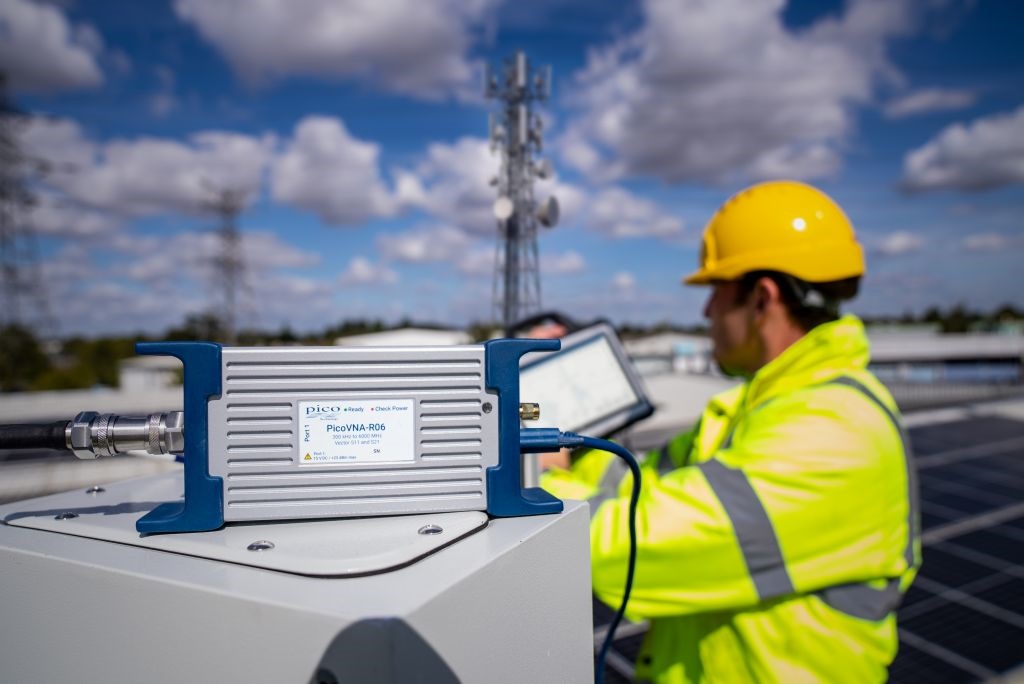
The PicoVNAs' small size, lightweight, and low cost suit them to field service, installation test, OEM embedded, and classroom applications. With their remote automation capability, they are also attractive in applications such as:
Software development kits, including code examples in MATLAB and MATLAB RF toolbox, LabVIEW, C, C#, and Python, are all available for download from Pico Technology’s GitHub pages. Examples include multiple instrument addressing and control.

Up to four display channels with two traces each allow multiple measurement quantities to be viewed simultaneously, such as Amplitude (logarithmic and linear), Phase, Group Delay, VSWR, Real, Imaginary, Smith Chart, Polar, and Time Domain. Eight markers, delta markers, fixed markers, peak/minimum hold functions, and automatic 3 dB and 6 dB bandwidth measurements are also available. A reference trace can be recalled from memory for each display channel.

The PicoVNA-R06 delivers a dynamic range of 80 dB at 300 kHz - 2 GHz (70 dB at 2 GHz - 6 GHz) and typically 0.008 dB RMS trace noise at its maximum operating bandwidth of 140 kHz.

PicoVNA-R is supported by most commercially available calibration kits as well as Pico’s precision PC3.5 SOLT calibration kits and E-Cal automated electronic calibration module.
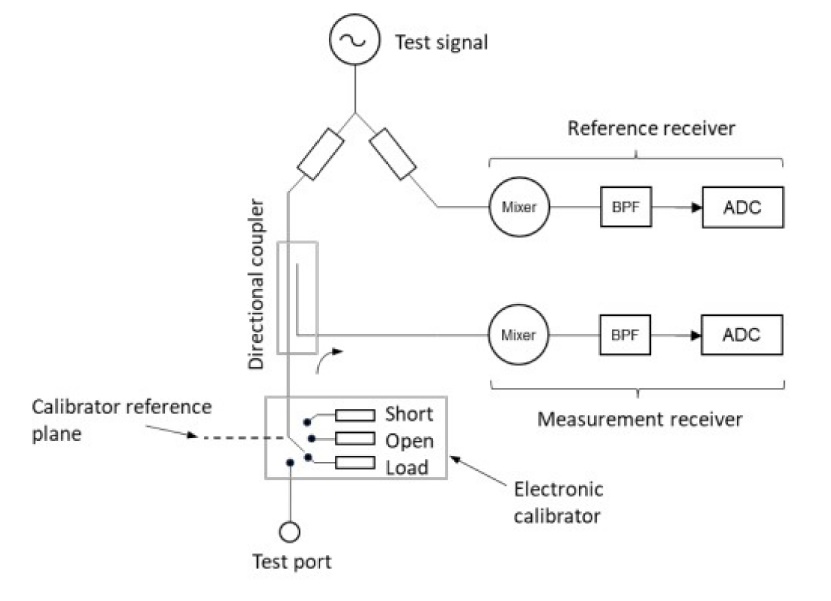
In the PicoVNA-R device, temperature drift in reflection coefficient (S11) measurements are significantly reduced thanks to a built-in electronic calibrator. This calibrator retrieves calibrations instantly by measuring and storing the reflection coefficient of built-in Short, Open and Load standards. Restoring a calibration works by re-measuring the same standards and computing the corresponding error terms. This technique is useful for field use where operation over a wide temperature range is likely, and indoor use, by providing near instant calibration after power on.

PicoVNA 5 software achieves compatibility with older computing hardware while making efficient use of modern hardware (PC, Mac, or embedded systems; x86-64 or AArch64, inclusive Raspberry Pi3B+ and up) to unlock new processing and feature possibilities.
With a PicoVNA-R06, PicoVNA 106 or PicoVNA 108 the PicoVNA 5 software enables you to customize an array of frequency domain and time domain viewports (display channels). In addition, you are able to add and group markers with comprehensive user configurable readouts, and be able to cross-reference memory traces. Organize all of this on a thoroughly modern, snappy, multi-port UI (User Interface). Whether local, network remoted or SCPI commanded; or an inter-acting combination of all three!
PicoVNA 5 has been designed for all our system and OEM embed integrators, that we know are out there. A high-performance API separately provides you (e.g. LabVIEW, MATLAB, Python users, etc.) with SCPI or API options when interfacing. Both the software and the API are designed to be capable of rapid expansion to meet ever-evolving user requirements; which we hope you will share with us via an in-application feedback utility. Ongoing development of PicoVNA 5 will port all functionalities of its predecessor PicoVNA 3 across to the new software.
While that continues, PicoVNA 3 remains available and fully supported as does its remote interface DLL.

Language: English
Version: MM163-1
File Size: 3.13 MiB
Release Date: 22.09.2026
functions and specifications
Language: English
Version: DO404-1
File Size: 1.22 MiB
Release Date: 21.09.2026