
Signal Generation and Analysis in One System
Expand your Magnova with a fully integrated function generator and powerful tools for analyzing electronic circuits. Signal generation, measurement and analysis work together seamlessly within the same working environment.
From precise test signals and arbitrary waveforms to sweeps and automated Bode Plots, the BMO-AWG supports typical development and laboratory tasks without requiring additional instruments or software.
| Technical Data | |
|---|---|
| Max. frequency | 90 MHz (sine) |
| Vertical resolution | 14-bit DAC |
| Frequency resolution | 1 μHz |
| Sample rate | 400 MSa/s with 1.6 GSa/s analog sampling 375 MSa/s with 1.0 GSa/s analog sampling |
| Min. rise time | 5 ns |
| Max. amplitude | 50 µVpp up to 20 Vpp 25 µVpp up to 10 Vpp 50 Ω load |
| Waveforms | Sine, square, pulse, ramp, DC, noise, arbitrary waveforms |
| Modulation functions | AM, FM, PM and DSB-SC, plus sweep and burst functions |
| Arbitrary waveforms | Extensive waveform library and user-defined waveforms with up to 32,768 points |
| Noise generation | Available as waveform, modulation source or overlay |
| Channels | 1 |
Key Features at a Glance

Generate and Shape Signals
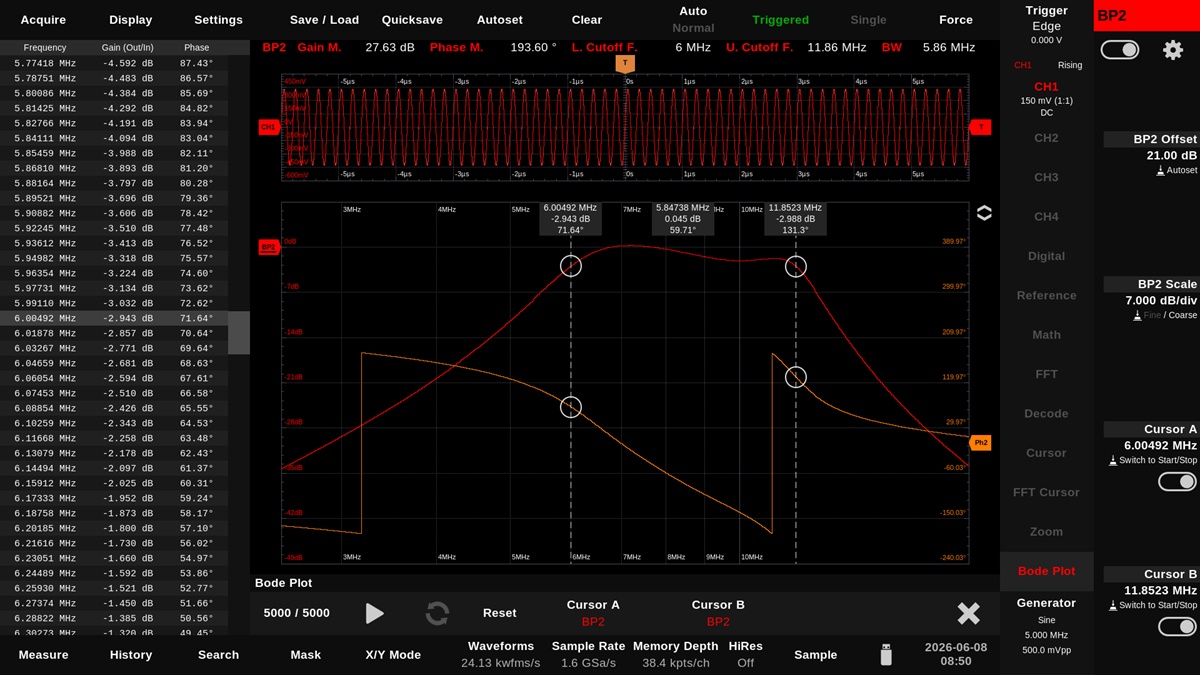
Generate sine, square, pulse and arbitrary signals up to 90 MHz directly within Magnova. Modulation, sweeps, bursts and noise overlay functions enable realistic test scenarios and flexible signal generation for development and troubleshooting.
Analyze Circuits
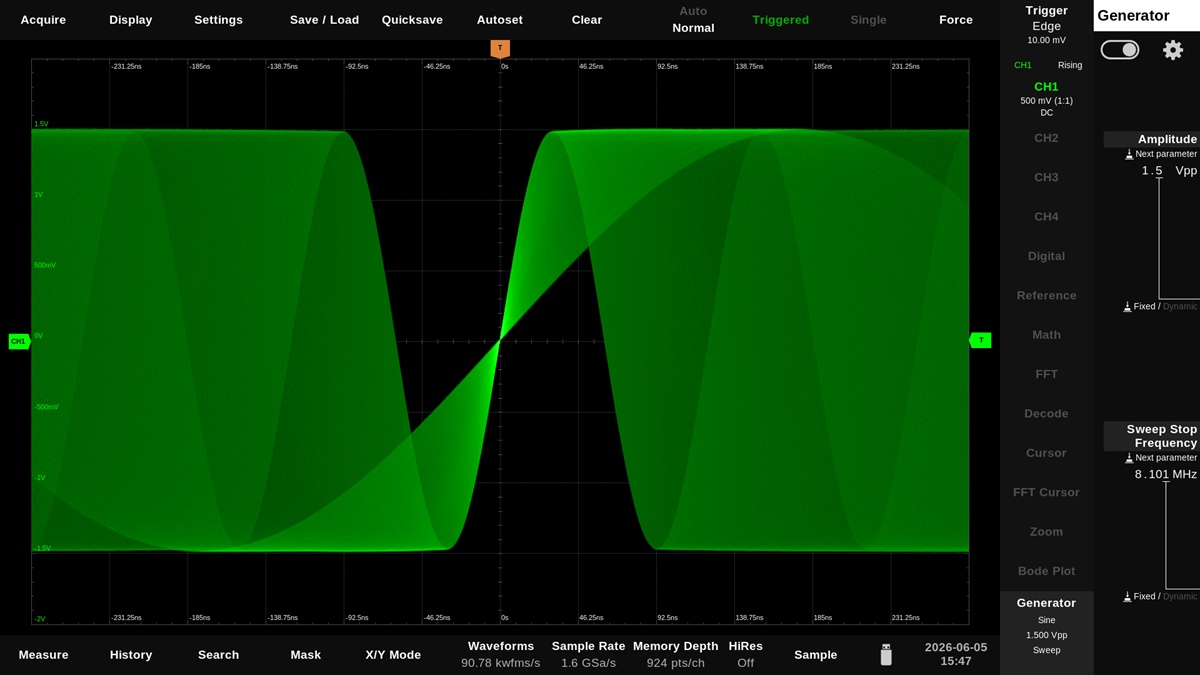
Examine gain, phase, bandwidth and cutoff frequencies directly within Magnova. Generator and oscilloscope work seamlessly together to create complete Bode Plots without requiring additional equipment.
Fully Integrated
The BMO-AWG is fully integrated into the Magnova Platform. Important parameters remain accessible at all times, generator settings are stored with setups, and new features are delivered through firmware updates.
Precise Signals for Development and Analysis
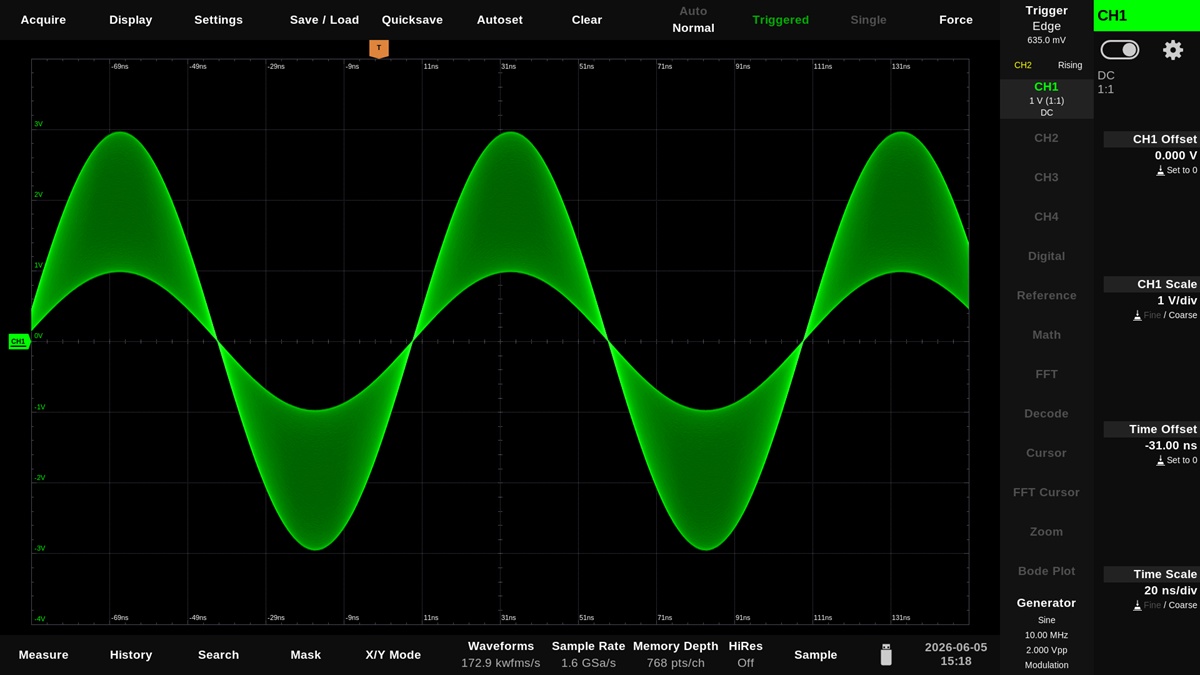
For demanding laboratory and development tasks, precise and reproducible signals are essential. High frequency stability, accurate amplitudes and low distortion provide the foundation for meaningful measurements and reliable test results.
Expand your Magnova with a fully featured function generator offering up to 90 MHz output frequency, 400 MSa/s sample rate and 14-bit resolution. Standard waveforms such as sine, square, pulse and ramp are immediately available and can be integrated directly into existing measurement tasks. In addition, the BMO-AWG supports AM, FM and PM modulation as well as sweep, burst and noise overlay functions for more demanding test and stimulation applications.

For more advanced applications, the BMO-AWG supports arbitrary waveforms, with many commonly used waveforms already available directly on the instrument, complete with graphical preview. Both carrier and modulation signals can be based on standard waveforms or arbitrary waveforms. This enables flexible implementation of even complex signal and modulation scenarios.
Custom waveforms can be stored, managed and reused for future measurement tasks. Import and export functions simplify integration with existing development and test environments. An integrated editor allows individual waveform points to be modified directly on the display. Various interpolation methods support adaptation of the waveform to specific application requirements.
Bode Plots – Characterize and Understand Circuits

Many characteristics of electronic circuits only become apparent when their behavior is examined across a wider frequency range. Filters, amplifiers, audio circuits, sensors and other analog building blocks do not respond equally at every frequency.
The generator provides defined stimuli while Magnova captures and analyzes the circuit response. The Bode Plot function automatically displays gain and phase response across the selected frequency range. Frequency and amplitude axes can be displayed in either linear or logarithmic form, simplifying the characterization of analog circuits.
Frequency response analysis from 1 mHz to 90 MHz is performed directly within Magnova. No additional instruments or external software are required.
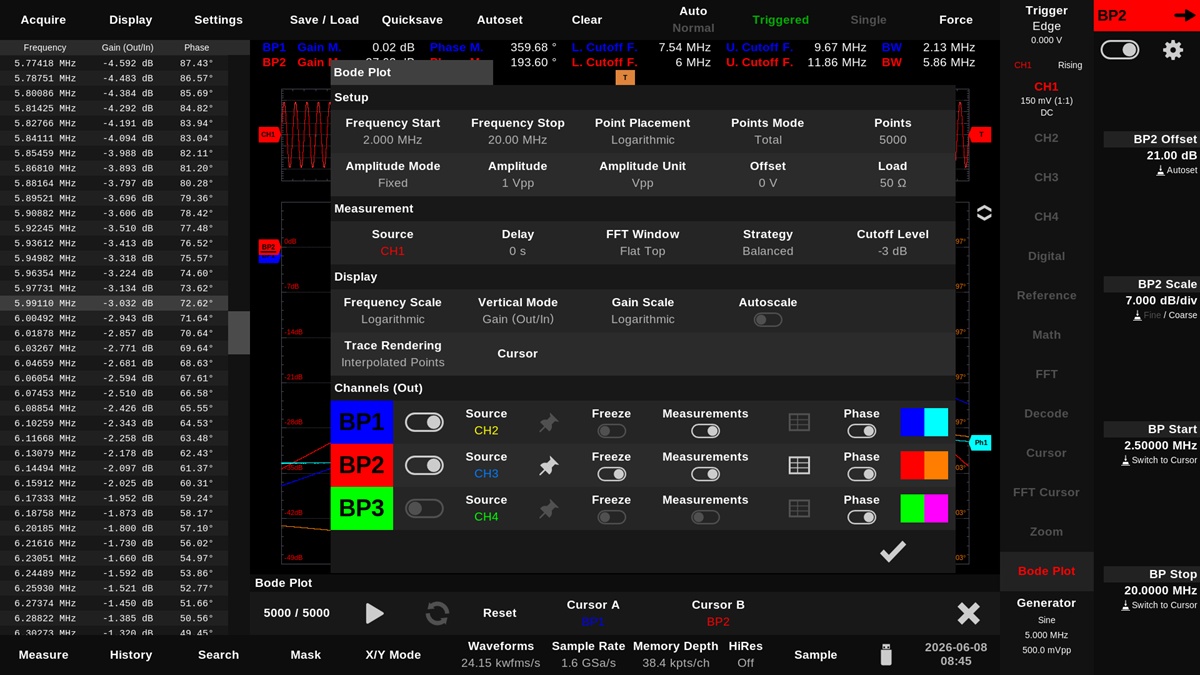
A test signal can be evaluated simultaneously using up to three Bode Plot channels. This allows different filter stages, amplifier stages or measurement points within a circuit to be compared in a single sweep.
Using the Freeze function, Bode Plot traces can be retained and compared directly with later measurements. Changes to components, circuit variants or parameters become immediately visible.
Cursors, table view and automatic measurements support direct evaluation. Bode Plot results can be exported individually for each channel and reused for documentation, archiving or further analysis.
Designed for Everyday Bench Work
The BMO-AWG was not designed as a separate accessory, but as an integral part of the Magnova system.
During measurements, important generator parameters remain directly accessible at all times. Frequency, amplitude and other settings can be adjusted using the Magnova FlexEncoders without changing menus or leaving the current working context.
All generator settings are stored together with setups and can be restored automatically through Quicksaves. This ensures that even extensive generator and analysis configurations remain reproducible.
In addition, generator events can be used directly to trigger measurements or can be output via the Auxiliary Output (Aux Out). Generator and Bode Plot functions can also be integrated into automated measurement and test procedures through remote control.
As part of the Magnova Platform, the BMO-AWG is continuously developed alongside the system itself. New functions and enhancements are delivered regularly through firmware updates and benefit from the same continuous software maintenance as Magnova.